
The “iron law of prohibition” is alive and well. An animal anesthetic related to – but worse than – xylazine (Tranq) is called medetomidine. It’s starting to be detected in samples of illicit fentanyl. Just what we don’t need: another adulterant in an already-deadly street drug. And it’s all predictable.
Attempts to rein in illicit fentanyl or control the chemicals used to synthesize it resulted in even more dangerous drugs, for example, fluorofentanyl, xylazine, nitazenes, and U-47700. Predictably, there’s a new kid on the block called medetomidine. How much harm will it do to drug users? Hard to say because the drug is not (yet) widely used to spike other drugs, especially fentanyl (1). But there are some clues from veterinary medicine, where it is routinely used as a general anesthetic.
Medetomidine – Xylazine on steroids
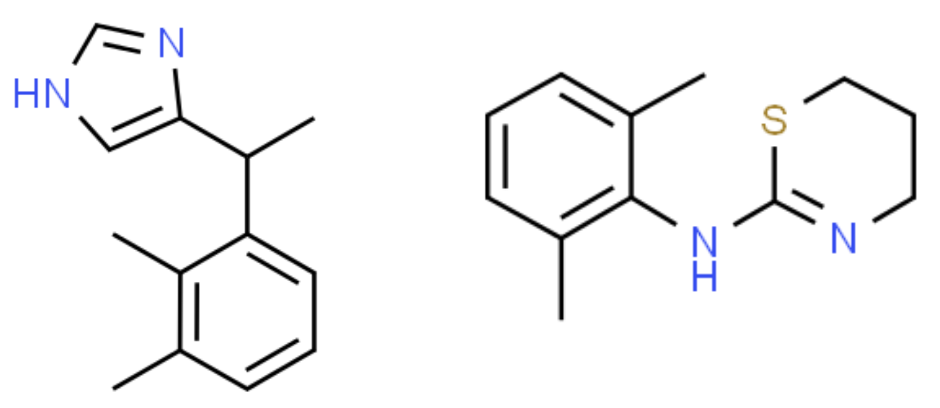
Medetomidine vs. xylazine
Medetomidine and xylazine are quite similar but have some differences. Both drugs are alpha-2 adrenergic agonists, (2) which are used for sedation, analgesia, and muscle relaxation, primarily in veterinary medicine (3). Here are some differences:
Medetomidine is stronger and longer-lasting (sedation and pain) compared to xylazine
Xylazine is less effective and less potent
Medetomidine causes more cardiovascular depression
Xylazine also causes cardiovascular depression but to a lesser extent
The key message here is potency, which is why it is an unwelcome guest in our fentanyl supply. How big is the difference? Pretty big.
The effective dose of medetomidine is 5-10 micrograms per kilogram (mpk) body weight of the animal.
By contrast, the effective dose of xylazine is about 0.5 to 1 mpk.
This makes medetomidine 100 times more potent than xylazine.
This number may be understated. A paper in the Journal of Ocular Pharmacology and Therapeutics reports that the difference in sedation and anesthesia is 200-fold.
https://www.acsh.org/news/2024/05/22/you-think-tranq-bad-meet-medetomidine-17860
 MOMMA J. CPS, HRS, MARS. BOLIVAR MO
Leave a comment