Fear of your parents’ old age
“There is a break in the history of the family, where ages accumulate and overlap, and the natural order is incomprehensible: there is a time when the child becomes the parent of his parents.”
This is when fathers grow old and walk slowly, slowly, confusedly, like walking in a mist.
This is when the parent who once held your hand firmly no longer wants to be left alone.
This is when the father, who was once strong and impenetrable, now takes two breaths before he gets up.
This is when the father, who once gave orders, now only sighs, only groans, and looks for where the door and window are—every street now feels far away.
This is when a parent, who was once full of will and hard work, now struggles to dress himself and forgets to take medicine.
And all we, their children, will do is accept this life that depends on our lives.
The life that gave birth to us now depends on our lives to die in peace.
Every child is the parent of his or her parent’s death. Perhaps, the old age of a father or mother is, in a strange way, the last pregnancy. Our last lesson. An opportunity to return the care and love they have given for decades.
And just as we adapted our homes for childcare, blocking electrical outlets and installing playpens, we will now rearrange the furniture for our parents.
The first change takes place in the bathroom. We will now be the parents of our parents, now installing a grab bar in the shower.
The grab bar is symbolic. The grab bar is symbolic. The grab bar initiates the “unsettling of water.”
Because the shower, which was simple and refreshing, now becomes a storm for the aging feet of our protectors. We cannot leave them alone for a moment.
The homes of those who care for their parents will have grab bars along the walls. And our hands will be spread out as railings.
Growing old is like walking holding things; growing old is like climbing stairs without steps. We will become strangers in our own homes. We will look at every detail with fear and unfamiliarity, doubt and anxiety.
We will become architects, designers, frustrated engineers. How could we not have seen that our parents would get sick and need us?
We will regret the sofas, the statues, and the winding staircases. We will regret all the barriers and carpets.
Lucky is the child who becomes his parents’ parents before they die, and unlucky is the child who comes only to the funeral and does not say a little goodbye every day.
My friend Joseph Kline accompanied his father until his last moments.
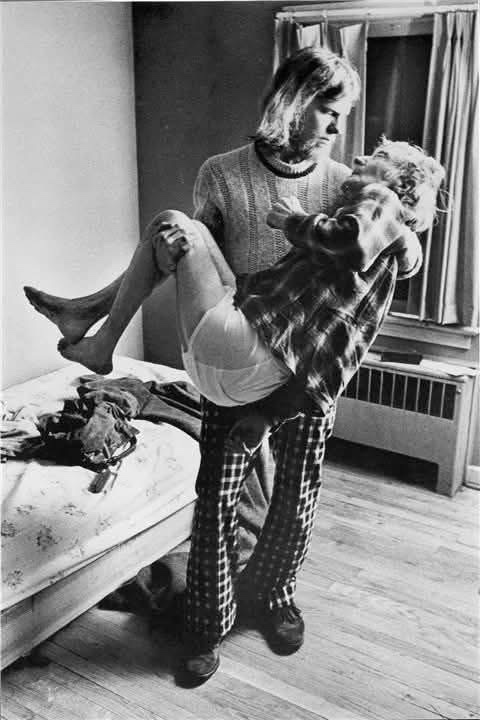
In the hospital, the nurse was turning to move them from the bed to the stretcher, trying to change the sheets, when Joe shouted from his seat: “Let me help.” He mustered his strength and took his father in his arms for the first time. He pressed his father’s face against his chest.
He held his father, swinging, small, wrinkled, fragile, trembling. He held him for a long time, the same time that was equivalent to his childhood, the same time that was equivalent to his adolescence, a long time, an infinite time. Rocking his father. Caressing his father. Bringing peace to his father. And he said softly:
“I’m here, I’m here, Papa!” “What a father wants to hear at the end of his life is that his child is there.”
I love you, Papa, wherever you are, I always think of you, I will never forget you!
Post From Social Media
Credit to its rightful owner
 MOMMA J. CPS, HRS, MARS. BOLIVAR MO
Leave a comment