💰 Dollar Differences: The 1950s Cost of Living Shock! 🤯 Time Machine Prices 🕰️
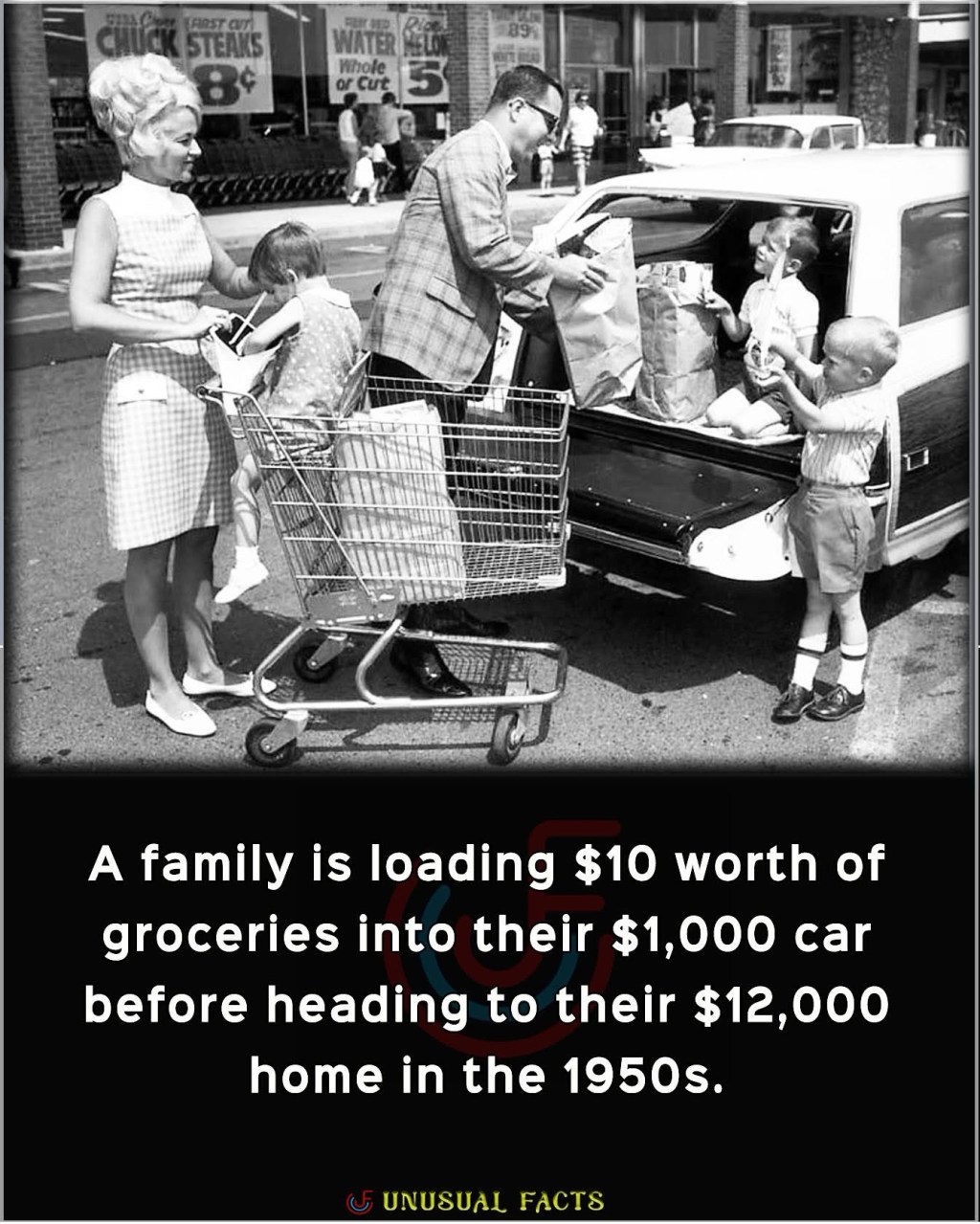
The image of a family in the 1950s loading $10 worth of groceries into their $1,000 car before heading to their $12,000 home paints a fascinating, if slightly skewed, picture of post-war American affordability. While the figures are close, the real average costs reveal a striking difference between then and now, especially when compared to average wages. 🤩
A Look at the Averages :-
The Home: The statement’s $12,000 home is accurate for the average cost of a new house, with prices often ranging from $9,000 to $15,000 during the decade. Crucially, in the 1950s, a house could be bought for about 2.5 to 3 times the average annual income (which was around $3,500 to $4,500). Today, that ratio is dramatically higher.
The Car: The $1,000 car is slightly below the decade’s average, as a new car (like a basic Ford or Chevrolet) generally cost between $1,400 and $2,000 during the 1950s. However, even at $2,000, a new car was still achievable for a single-income family.
The Groceries: The $10 grocery haul would have been a substantial shop! A loaf of bread cost about $0.16, a gallon of milk was around $0.90, and ground beef was about $0.50 a pound. A $10 purchase would easily fill the trunk of that new sedan. 💔
The Real Economic Shift :-
While the nominal prices were low, the true difference between the 1950s and today lies in the affordability ratio.
Affordability: The 1950s were defined by a significant post-war economic boom for the middle class. While the cost of food and clothing consumed a much larger percentage of the average income than they do today, the cost of housing and education was relatively low and accessible to single-income households.
The Trade-Off: Families in the 1950s enjoyed a low cost of entry into home and car ownership. However, they had fewer modern conveniences: houses were smaller, often only had one bathroom, and there were no cell phones, internet, or streaming services.
A Different Priority: The comparison highlights how the American dream of home and car ownership was structured to be much more financially attainable for the average worker than it is in the modern era, despite current wages being numerically higher. 🙏
 MOMMA J. CPS, HRS, MARS. BOLIVAR MO
Leave a comment