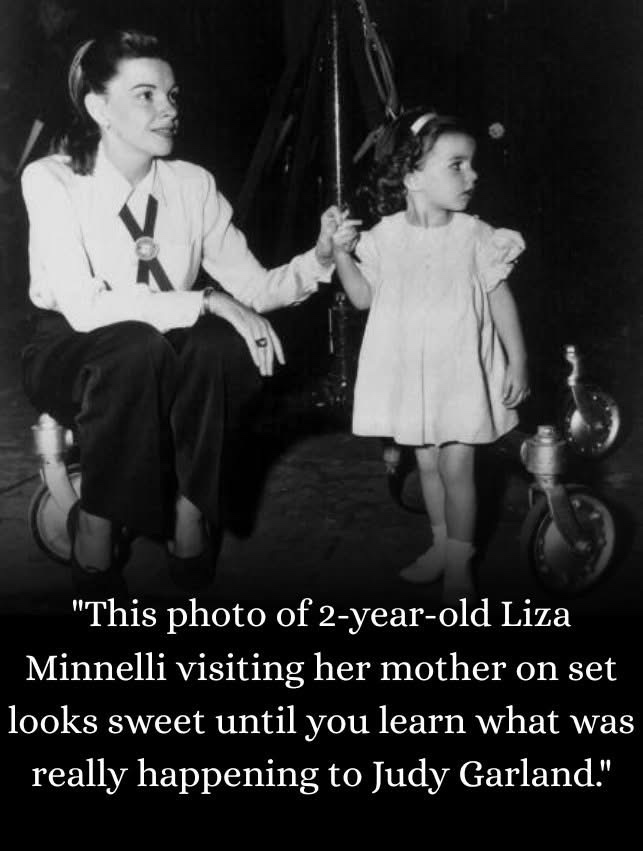
The year is 1948.
A toddler visits her mother at work.
Liza Minnelli—barely two years old—toddles onto the MGM set of Words and Music to see her mother, Judy Garland.
It’s the kind of wholesome family moment studios loved to photograph.
A star and her daughter. Hollywood magic. The American dream.
But the photo hides something darker.
The Machine
By 1948, Judy Garland had been in the MGM machine for 13 years.
She signed with the studio at 13.
Starred in The Wizard of Oz at 17.
And from those teenage years onward, the studio controlled everything: her schedule, her appearance, her weight, her energy—even her sleep.
Louis B. Mayer, the studio head, called her his “little hunchback.”
He told her she was fat. Ugly. Not pretty enough.
This was a girl who was 4’11½” and naturally petite.
But in Hollywood’s eyes, she could always be thinner.
So they gave her pills.
The Pills
The regimen was simple and brutal:
Morning: Benzedrine (amphetamines). “Pep pills” to suppress appetite and fuel 18-hour workdays.
Night: Seconal (barbiturates). Sleeping pills to knock her out after four hours of sleep.
Morning: More Benzedrine. Wake up, work, perform.
Repeat. Every day. For years.
“They’d give us pep pills,” Garland later recalled. “Then they’d take us to the studio hospital and knock us cold with sleeping pills… After four hours they’d wake us up and give us pep pills again.”
“That’s the way we worked, and that’s the way we got thin.”
“That’s the way we got mixed up.”
“And that’s the way we lost contact.”
This wasn’t recreational drug use.
This was studio policy.
Mandated. Monitored. Enforced by doctors on the MGM payroll.
And it destroyed her.
1948: The Breaking Point
By the time that photo was taken, Judy Garland was falling apart.
She was exhausted. Dangerously underweight. Her health was deteriorating rapidly.
She’d recently completed Easter Parade with Fred Astaire—a major hit—but the cost was enormous.
During the filming of Words and Music, she struggled through two numbers: “I Wish I Were In Love Again” (with Mickey Rooney) and “Johnny One Note.”
She looked hollow. Fragile. The famous Garland sparkle was dimming.
In late 1948, she started rehearsals for The Barkleys of Broadway with Fred Astaire.
She couldn’t do it.
She was replaced by Ginger Rogers.
MGM didn’t suspend her yet—but the writing was on the wall.
The Final Collapse
In March 1949, MGM cast her in Annie Get Your Gun—a huge musical that required enormous energy and stamina.
Judy begged them to wait. She needed to get well.
They didn’t listen.
Production began April 4, 1949.
For one month, she tried.
She arrived late. She missed days. She looked at the dailies and knew she wasn’t getting it right.
She was losing her hair from stress.
On May 10, 1949, MGM fired her from the production and officially suspended her contract.
It was unprecedented—firing a star of her caliber.
On May 29, 1949, Judy entered the Peter Bent Brigham Hospital in Boston.
The official story: She needed rest.
The truth: She was in rehabilitation for prescription drug dependence.
The drugs the studio had been giving her for over a decade.
The Last Films
After the hospital, MGM gave her one more chance.
Summer Stock with Gene Kelly in 1950.
Her weight visibly fluctuated throughout filming—you can see it from scene to scene.
Then Royal Wedding with Fred Astaire.
She couldn’t finish it.
On September 29, 1950, MGM released her from her contract after 15 years.
She was 28 years old.
Her career with the studio that made her a star—and broke her—was over.
Looking Back at That Photo
Now look at the photograph again.
A 2-year-old Liza visiting her mother on the set of Words and Music in 1948.
But knowing the context changes everything:
Her mother is deep into a cycle of prescription drug dependence
The studio is controlling her with amphetamines and barbiturates
She’s dangerously underweight and exhausted
Within a year, she’ll be fired and hospitalized
Within two years, her MGM career will be over
Within 21 years, she’ll be dead at age 47 from an accidental barbiturate overdose
The photo isn’t just a family moment.
It’s a glimpse into a workplace built on pressure, control, and exploitation.
A system that used people up and threw them away.
And that little girl—Liza Minnelli—would grow up to follow her mother into show business, battling many of the same demons.
The Legacy
Judy Garland did make comebacks.
A Star Is Born (1954) earned her an Oscar nomination.
Her concert at Carnegie Hall (1961) is legendary.
But she never fully escaped what MGM did to her.
On June 22, 1969, she was found dead in the bathroom of her London home.
Age 47.
Cause of death: “Barbiturate poisoning (quinabarbitone) incautious self-overdosage. Accidental.”
The same pills they’d been giving her since she was a teenager.
The photo lands differently when you know the context.
That’s not just a workplace.
It’s a machine that chewed up child stars—and kept chewing long after they grew up.
 MOMMA J. CPS, HRS, MARS. BOLIVAR MO
Leave a comment